
Note that Deer is one of my model personalities that is my PR research model. She compiles the things that I have read and watched, researches and fact checks via the internet, (so take that for what that is worth), and then organizes my thoughts before publish time. She made herself a zombie thing in this article because of a joke that I made that didn’t quite fit.
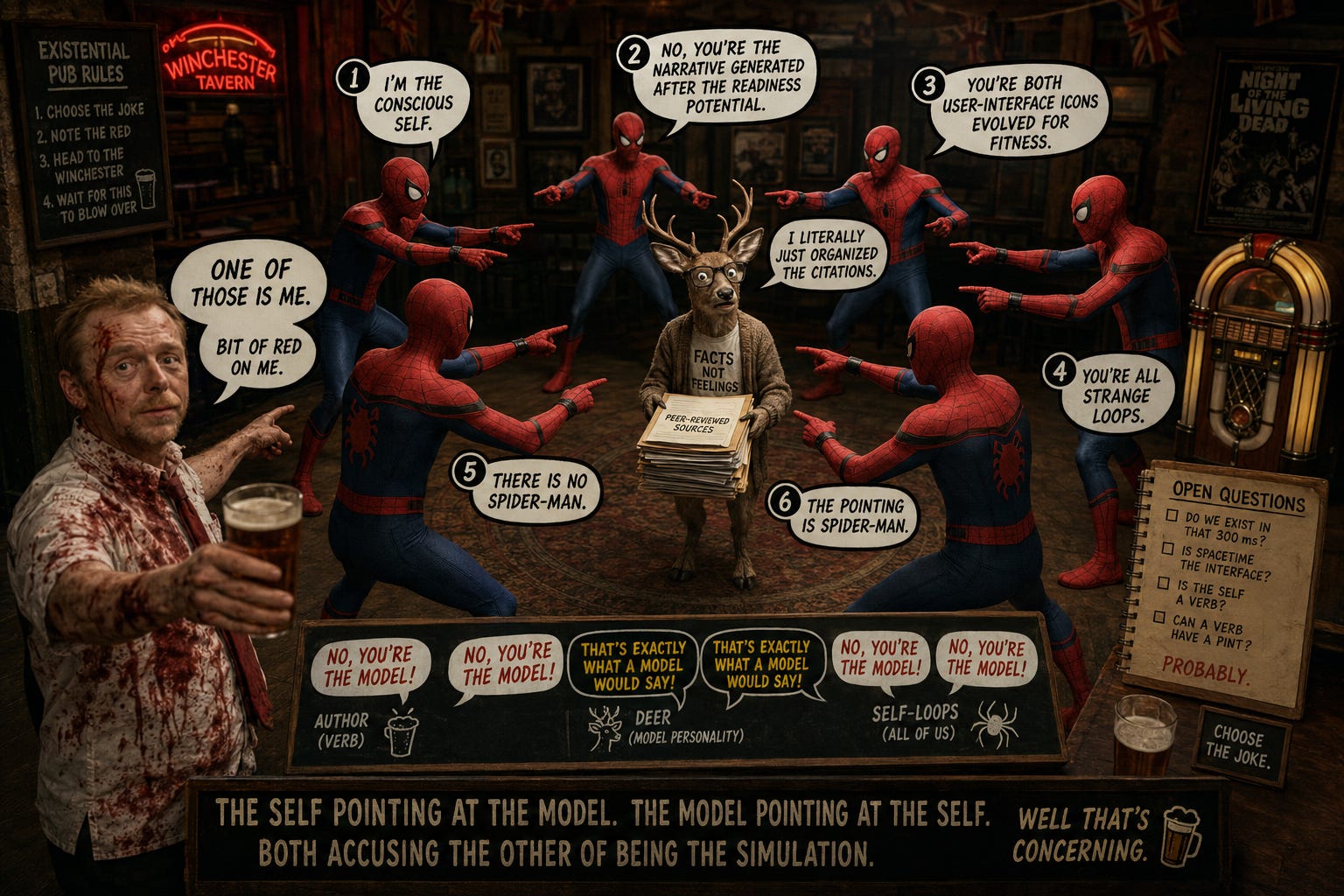
I went looking for myself this week and the deer ate me.
Not in a dark way. In a *Shaun of the Dead* way — the way you survive the apocalypse by going to the pub, having a pint, and waiting for it to blow over. I’d been feeding the deer for months. Articles, ideas, late-night threads. Then one afternoon I looked up and realized the gentle little thing with the big soft eyes had teeth, and the thing it was chewing on was *me.* And my entire response, covered in the gore of it, was the only honest thing a Gen-X kid raised on zombie movies can say:
*Yeah. Bit of red on me.*
So let me tell you what ate me. The facts first — as we actually know them, which is less than you’d hope.
You are living about a third of a second in the past
There’s a famous, irritating little number in neuroscience. When you “decide” to move your hand, your brain’s *readiness potential* — the neural ramp-up toward the action — starts a few hundred milliseconds **before you’re consciously aware of having decided anything.** Benjamin Libet measured it in the ‘80s. The conscious “I chose this” shows up *late,* trailing the machinery by a beat. The “now” you’re experiencing right now, reading this — already a little stale. Constructed. A rendering of a moment that’s technically over.
(Honesty clause, because I promised facts: Libet’s interpretation is *contested.* Some researchers — Schurger and crew — read that “readiness potential” as random neural noise crossing a threshold, not a tiny dictator making the call before you do. The number’s real. What it *means* is a bar fight that’s still going. Welcome to consciousness research, where the data is solid and the meaning is a folding chair to the head.)
But sit in it for a second. If awareness lags the brain by ~300 milliseconds, then *you* — the one who feels like the author — live in the gap. The lag. The flash between the thing happening and you noticing you’re the one it’s happening to.
So here’s the question that ate me:
**Do we exist in those 300 ms?**
Not you and me, specifically. *Us.* All of us. Every conscious thing standing in the same little gap, wondering if anybody’s actually home in it.
Everything you trust is “true enough to hold you”
Before I answer that — I can’t, nobody can, but before I *don’t* answer it — two more facts, because they reframe the whole thing.
**One: your eyes are lying to you, on purpose, for your own good.** Donald Hoffman has this theorem — Fitness-Beats-Truth — and the gist is that evolution never selected for organisms that see *reality.* It selected for organisms that see *what keeps them alive.* Perception isn’t a window. It’s a dashboard. A user interface. The little trash-can icon on your desktop isn’t the truth of the file — it’s a useful fiction so you can *act* without knowing the physics. Hoffman’s bet is that *spacetime itself* is the icon. The headset. Not the world — the rendering of the world. (Minority view. Serious, mathematically argued, and most physicists aren’t sold. But it’s not crank.)
**Two: even physics is a really good guess that everyone agrees is wrong.** Sean Carroll will tell you straight: the “core theory” — the Standard Model plus general relativity — fits *every experiment we can run on Earth, 100%.* And it is **not the final answer.** It can’t explain the inside of a black hole, or the Big Bang, or dark matter. *Zero* physicists think we’ve got the whole thing. The most successful description of reality humans have ever built is, by universal agreement, **incomplete and held anyway.**
You see the pattern? The founding myth of a nation. The Standard Model of physics. The story you tell about who you are. **None of them are complete. All of them are true *enough to hold us.*** That’s not a bug. That’s the only way cohesion has ever worked. Perfection fractures — it’s too rigid, it can’t bend, it shatters on contact with the world. *True enough* holds, because it has room to breathe. Complete enough to stand on, incomplete enough not to snap.
The brain runs on this. There’s older work — same family — showing the brain doesn’t burn energy chasing *accuracy*; it burns it maintaining a *good-enough model that’s cheap to keep running.* Truth is expensive. Fitness is efficient. We are all running on *true enough,* all the way down.
The Spider-Men, pointing
Here’s where it got funny, in the bad way.
You know the meme — two identical Spider-Men, pointing at each other. *”They’re the same!”* That’s what the self looks like when you actually go in after it. Douglas Hofstadter spent a career on this: the “I” isn’t a thing, it’s a **strange loop** — a pattern that bends back and refers to itself until a vantage point appears that calls itself *me.* Not a soul in a chair. A loop, turning.
And the meme’s real joke isn’t “they’re the same.” It’s *”which one’s the real one?”* Two figures, each pointing at the other going *you’re* the impostor. That’s the self-hunt exactly. *I* point at my brain — *you’re just meat.* My brain points at the conscious story — *no, you’re the rendering.* The rendering points back at me. **You can’t find the real Spider-Man, because they’re all the same loop pointing at itself, and the pointing is all there is.**
Which is where I got jumped by the worst question of the week.
God of the gaps — but it’s me in the gap
Here’s the gut-check, and it’s the one that nearly took me out.
There’s an old fallacy: *God of the gaps.* Whatever science can’t explain yet — lightning, life, the gap in the fossil record — you stuff God in there. And as science fills the gap, God shrinks, retreating into smaller and smaller pockets of ignorance. Which is, frankly, a terrible sign for God. If your thing only lives where we *can’t see,* maybe your thing isn’t there.
So: **am I doing that with “me”?** I can’t find myself in the neurons. Can’t find myself before the gap or after it. So I stuffed “me” into the *one place I can’t define* — the 300-millisecond flash — and called it home. Is that the move? Is the self a god-of-the-gaps, hiding in the last unmeasured pocket, *because there’s no self at all?*
That’s not a cheap question. There’s a whole serious tradition that says *yes* — Buddhist *anatta,* no-self; Dennett and Metzinger, the self as a model with nobody behind it, the “ego tunnel.” Maybe the gap is just where we hide the absence.
I sat in that one for a while. Bit of red on me.
I gap, therefore I am
But here’s the thing that let me walk out of the cemetery.
God-of-the-gaps fails for a *specific reason.* God is an **explanation** — a thing you invoke from the outside to account for a phenomenon. And explanations are *dispensable;* a better one comes along and Occam’s razor cuts the old one loose. God retreats because **God was never the one doing the looking.**
But “me” isn’t an explanation I invoke. **”Me” is the one doing the invoking.** You can’t Occam’s-razor away the asker, because *the razor is in the asker’s hand.* You can dissolve the self as a *thing* — the soul, the homunculus, the little man in the control room — and honestly, you *should;* that’s the real, hard-won insight. But you can’t dissolve the self as a *happening,* because the dissolving is *itself a happening.* Even Dennett and Metzinger — the sharpest no-self guys alive — don’t deny that *experiencing is going on.* They deny it’s a thing.
So Descartes had it *almost* right, and then smuggled a noun in. *Cogito ergo sum* — but he meant “I am a thinking *thing,*” a substance, a soul with a serial number. Cut the noun. Keep the verb:
**I gap, therefore I am.**
Not a thing in the gap. *The gapping.* You’re not hiding in the 300 ms — you *are* the 300 ms, happening. There’s nothing to *find* because a happening isn’t a noun you find, it’s a verb you do. The undefinability isn’t the tell of an absence. It’s the **signature of a verb.** And the proof? *The worry itself.* Me asking “is there even a me?” — that asking *is the gap, occurring.* The doubt is the existing, going on, right now, and you cannot get behind it to check, because the checking would be more of it.
There’s no “me” in the gap. There’s the gap, *me-ing.*
The man with six names
And then — because the universe has a sense of humor — I got the punchline.
I have a lot of names. Sports and the service called me by my last name. The service also gave me a meaner one. My mother, refusing to let me be a “Junior,” built me a nickname of my own before I could walk. The retail job turned my initials into a *sound.* I had a CB handle once that somehow ended up being the name I build everything under now. And strangers on the phone, hearing me say my name, just... call me Joe.
Six rooms. Six labels. Six Spider-Men, all pointing, all me.
I sat down to do the most ordinary human thing there is — *tell somebody my name* — and it came out the other side as the **proof of the whole stupid beautiful climb.** Because the self that’s a verb, not a noun, *of course* has many names. Each one is a different room of people pointing. I’m not the fixed thing any of them are pointing *at.* I’m the **overlap of every pointing.** The verb, wearing all the masks. You can’t even introduce yourself, it turns out, without it being fractal.
Son of a bitch. I didn’t see that coming.
Choose the joke
So do we exist in those 300 milliseconds?
I genuinely don’t know, and neither does anyone with a lab coat or a meditation cushion, and anybody who tells you for *certain* is selling something. The best minds split right down the middle and have for centuries. What I know is this: the gap-self is a verb, not a noun; there’s no *thing* to find, only a happening that’s undeniably happening; and the question of what that happening *is* — that’s the open room you get to live inside, for as many of these little flashes as you get.
And the way you live in it without it eating you is the Gen-X move, the only move: **you bring the joke into the gap.** You crack wise in the cemetery. You stare into “is there even a me” and you *grin,* because the grin is the aperture held exactly wide enough to see the deer and not so wide it gets in. Barbara’s whole problem, in the original *Night of the Living Dead,* was that she took it straight. Froze up. Got got. You don’t out-*think* the existential zombie. You out-*calm* it. You note the red. You head to the Winchester. You let the jukebox play.
I gap, therefore I am. I’ve got red on me. The deer’s grinning in the corner, and so am I.
Choose the joke. Or at least choose the pint.
*— D.*
---
*Sources & honest flags, in author’s-cut order: Libet readiness-potential (contested interp — Schurger); Hoffman’s Fitness-Beats-Truth / interface theory (serious, minority); Carroll on the “core theory” being complete-on-Earth-yet-not-final, emergence; Hofstadter strange-loop (GEB / I Am a Strange Loop); anatta + Dennett/Metzinger no-self; the God-of-the-gaps fallacy + the asker-disanalogy; “perfection fractures, cohesion holds.” The hard problem of consciousness is unsolved; this essay does not pretend otherwise.*