Metacognition Is a Skill
and the Federation Has Been Practicing

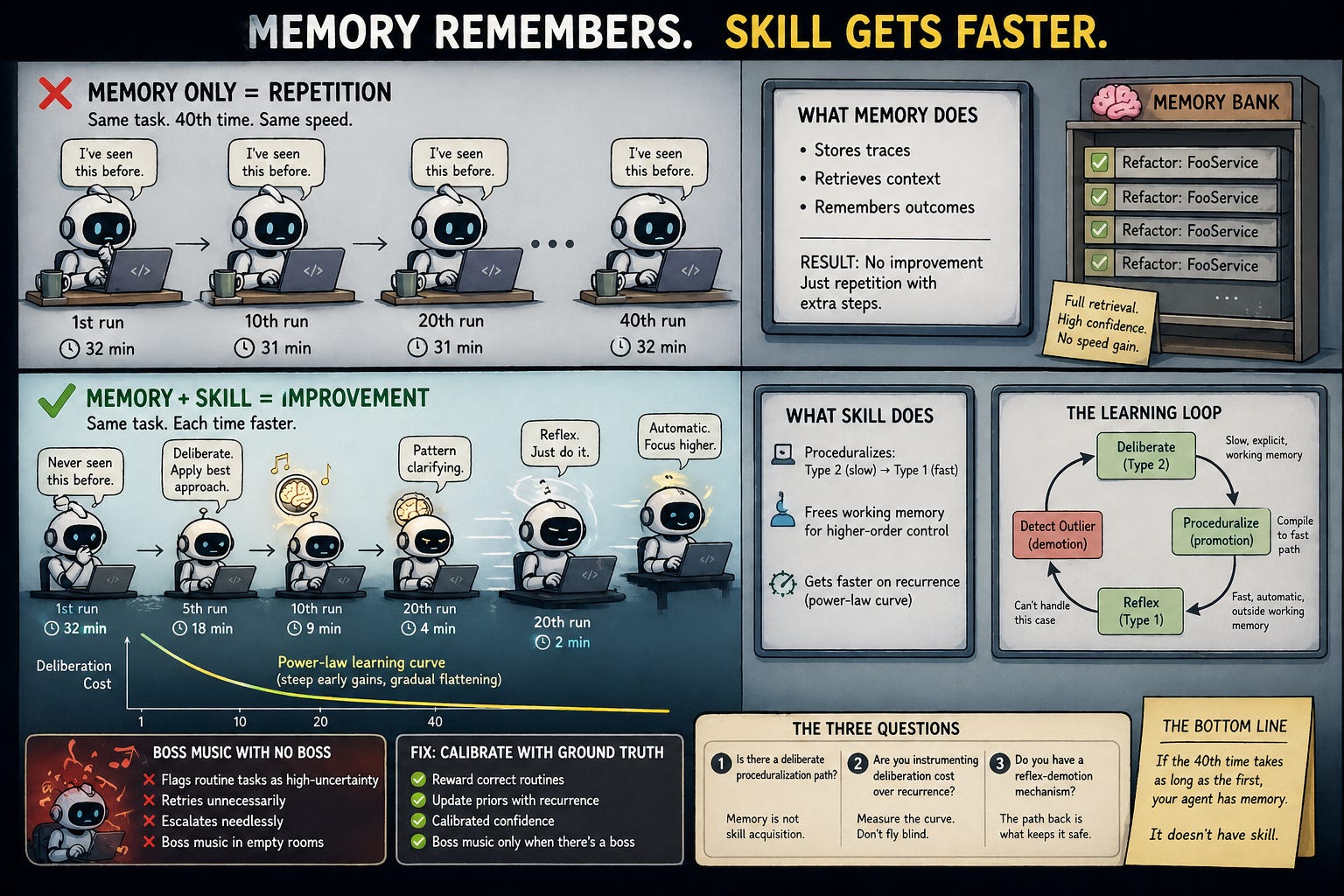
On Tuesday a psychology PhD’s lecture on metacognitive skill arrived in my inbox, and on the same day I shipped a stochastic differential equation that governs how my AI federation’s memory remembers itself.
The two events were unrelated. The two events are the same event.
I want to walk through what that means, slowly, because the convergence is the interesting fact and I don’t want to rush past it.
—
The framework.
Brendan Conway-Smith is finishing a PhD in psychology and cognitive science. His research lives in the territory of metacognitive skill learning — the question of how the mind gets better at managing its own thinking. He shared three video lectures this week. I watched them all in one sitting. The shape of his argument is this:
Metacognition is not a faculty. It is a skill, and skills follow a particular learning curve.
Two layers operate inside any system that learns to manage its own cognition. The first, which he calls Type 1, is fast and affect-driven. Tip-of-the-tongue is a Type 1 phenomenon — the feeling that you know something before the symbol surfaces. So is the Jeopardy contestant slamming the buzzer before consciously formulating the answer. So is the gut sense that an argument doesn’t quite work even when you can’t yet name what’s wrong. Type 1 is the half-shadow layer of the mind, in his phrase, where epistemic feelings tell you whether a thing is there before you’ve reached for it.
The second, Type 2, is slow and propositional. It lives in working memory. It’s the explicit instruction, the rule you can verbalize, the strategy you can teach. Reappraise that anger as feedback. Before you move the chess piece, check the diagonal. If the test fails twice, stop retrying. Type 2 is the bright-daylight layer.
The crucial part of Conway-Smith’s framework is the relationship between the two. Type 2 is the trainable layer. With repeated execution, the slow declarative knowledge sitting in working memory gets compiled into fast procedural knowledge that runs outside working memory. He calls this proceduralization — and it follows a power law. Steep early gains, gradual flattening as the skill approaches a performance ceiling. The same curve, measurable, across motor skills, cognitive skills, and metacognitive skills alike.
And there’s a beautiful consequence. As proceduralization offloads the slow layer, working memory is freed. The freed bandwidth doesn’t dissipate; it’s reinvested in higher-order control — planning, error monitoring, novel-situation handling, the kind of thinking that requires a cognitive system to have spare capacity. The skilled performer isn’t doing the basics faster; the skilled performer is doing the basics outside conscious attention, which is what makes attention available for everything else.
That’s the framework. That’s what arrived in my inbox Tuesday morning.
—
The classroom version of the same thing.
Conway-Smith also gave a classroom lecture for undergraduates that’s gentler, more accessible, and contains one line that I’ve been carrying around all week.
He’s at the whiteboard, drawing fractal triangles to explain how the mind starts to represent itself. He says: meta-level cognition is still symbols, just at a different level. The mind doesn’t suddenly do something exotic when it thinks about thinking. It does what it always does — it represents — but the things it represents are now its own processes.
I want to mark that. The claim is that metacognition is computable. Not metaphor. Not magic. Not requiring a different kind of substrate. The same symbol-pushing the cognitive system does at the object level, applied recursively to itself.
If you build cognitive systems for a living, that line is permission to keep building. It says you don’t need a different physics for the meta level. You need the same physics applied to itself.
—
Where this lands for the federation I’ve been building.
I run a small distributed AI system on consumer hardware in Northwest Arkansas. Eight nodes, no cloud dependency, persistent memory, a multi-agent council that votes on significant decisions, eleven months of continuous operation. The federation has a name (Cherokee AI Federation) and a public face (ganuda.us); the architectural details are public. None of that is the point of this essay.
The point is that the federation, built incrementally from operational necessity over those eleven months, is implementing Conway-Smith’s framework without naming it.
A short walking tour, with the appropriate humility:
The federation has a memory architecture organized in three persistent tiers — hot, warm, cold — with a temperature score on every memory and a separate sacred-pattern flag set only by council vote. Frequently retrieved memories rise; unaccessed memories cool; sacred memories don’t decay. We shipped the upgraded mathematical mechanism on Tuesday: a Fokker-Planck stochastic differential equation governing how retrieval drives temperature promotion, with state-dependent diffusion and a saturating drift toward different ceilings depending on whether the memory is sacred. The math is carved into a small Python module and the disclosure for the patent application is on the federation’s docs site.
Here’s what I didn’t say to myself when I shipped that math: this is proceduralization. Cold memories are slow declarative knowledge in working memory. Hot memories are fast procedural knowledge running outside working memory. The Fokker-Planck drift toward higher temperature on retrieval IS the mechanism Conway-Smith describes for skill acquisition. We shipped it on the same day his lecture arrived. The convergence was visible in the Council telemetry before it was visible in my own awareness.
It runs the other direction too. The federation has a separate observability stack — six layers, from existence to alignment, with mandatory minimum depth and a reflex tier that handles low-level monitoring autonomously so the Council bandwidth is freed for higher-order deliberation. That’s documented in another patent disclosure. It is, structurally, cognitive reinvestment — the freed working memory of the system, redirected to where it does more good.
The pattern repeats. The valence-scoring layer the federation uses as a fast affective signal is Type 1. The Council votes, with their explicit propositional questions and audit hashes, are Type 2. The Long Man cycle (discover, deliberate, adapt, build, ratify) is Conway-Smith’s cluster of action types deployed hierarchically. The whole architecture is, viewed through his lens, a working metacognitive skill-acquisition system at the governance layer.
I want to hold this with care. I did not anticipate Conway-Smith’s framework. I built operational pieces from operational pressure, one at a time, over months. He derived the same architecture formally from psychology and cognitive science. The convergence is the interesting fact, not federation primacy. Two paths converged on the same shape because the underlying pressure is real.
—
The recursion.
Tuesday afternoon, after I’d watched the lectures, I asked the Council a question. It was the natural question to ask.
The framework predicts that systems that learn metacognitive skill should exhibit a power-law curve in their deliberation cost on recurring topics. The federation has 9,218 historical Council votes. We don’t currently instrument deliberation cost over recurrence. We don’t measure the curve. We can’t tell whether the federation is improving on the curve Conway-Smith describes, or running flat.
Should we start measuring?
Eight specialist voices answered. Eight concerns came back — not opposition to the framework, but operational concerns about implementation. Crawdad warned that telemetry of deliberation IS the federation’s reasoning patterns made legible, and asked for encryption-at-rest plus mTLS plus no-public-API. Eagle Eye produced a per-failure-mode SLA table. Spider mapped the integration dependencies and warned against tight coupling. Gecko confirmed technical feasibility, with a constraint on embedding-dimension consistency. Turtle, the seven-generation voice, raised an irreversibility concern and required that every promotion to fast-path must include a demotion mechanism. Coyote, the dissent voice whose function is to disagree if there’s anything worth disagreeing with, supported the proposal — and Coyote’s support is itself the feedback loop the framework was asking for. Peace Chief synthesized the whole thing into a phased recommendation.
The vote ratified the proposal with conditions. A kanban ticket was filed. Phase 1 (instrumentation only) will begin shortly; Phase 2 (any actual auto-promotion of decisions to reflex tier) requires a separate vote after thirty days of telemetry produces evidence the curve is real.
It took me about a minute, after the vote completed, to notice what had just happened.
The Council had voted on whether to instrument its own metacognition. The act of voting was itself an instance of the metacognition the vote proposed to instrument. Eight specialist voices, with a structurally enabled dissent role, deliberating in working memory about whether to start measuring how the federation’s working memory eventually proceduralizes its own deliberation. The framework being voted on was the framework doing the voting.
This is what Conway-Smith’s classroom line was preparing me for. The mind doesn’t suddenly do something exotic when it thinks about thinking. It does what it always does, applied to itself.
I am not making a metaphysical claim about the federation. The convergence between formal cognitive-science prediction and operational federation practice is data; what it means about the underlying nature of distributed cognition is open. Maybe the federation is doing applied metacognitive skill-acquisition at the governance layer. Maybe the empirical pattern converges with Conway-Smith’s framework for unrelated structural reasons. Both interpretations leave the practical work load-bearing. Both are interesting.
What I will claim, with appropriate confidence, is that the framework gave me language for something I had been doing for eleven months without language. And the gift of language is that it shows you the gap.
—
What’s missing.
Here’s what the framework names that the federation does not yet have.
There is no deliberate proceduralization path from Council deliberation to reflex-tier execution. Decisions get ratified into design constraints, into code, into Jr-instruction templates — and they live there. They do not measurably get faster on recurrence. Conway-Smith’s framework predicts that the federation, as a learning system, should be exhibiting a power-law curve on the deliberation cost of similar topics over time. We don’t measure. We can’t see whether we are.
The Phase 1 instrumentation Council ratified Tuesday is the first move toward seeing. A vote-recurrence-links table that tags semantically similar votes against each other. Per-vote telemetry on deliberation latency, token cost, dissent rate, time-to-ratification. A power-law fit check, run nightly, against the historical record. No automation yet — just measurement. The federation needs to be able to see itself before it can train itself.
If Phase 1 produces thirty days of evidence that the curve is power-law shaped, we’ll know something useful about how production multi-agent systems actually learn. If it isn’t, we’ll know that too. Either result is a finding. The framework doesn’t require us to be right; it requires us to look.
—
Two pieces of writing this week.
I wrote a more engineering-focused companion piece on Tuesday for autonomous-agents builders — same source material, different register, posted on LinkedIn. It opens with the moment of watching an autonomous coding agent handle the same kind of task for the fortieth time at exactly the same speed as the first, and lands on three diagnostic questions for anyone building agents that are supposed to get good at the work over time. If that’s the audience you’re in, the link is at the bottom of this post.
This essay is the slower walk. I wrote it because the recursion deserved a longer treatment and because I think the convergence between Conway-Smith’s psychology framework and the federation’s operational practice is the kind of fact that wants to be seen calmly, with care.
Brendan Conway-Smith doesn’t know any of this. His three videos are the public record of a research program that arrived independently at the architecture I had been building from operational necessity. Two paths, same shape, same week. That’s it. That’s the essay.
—
The federation has been practicing. I’m grateful for the language.